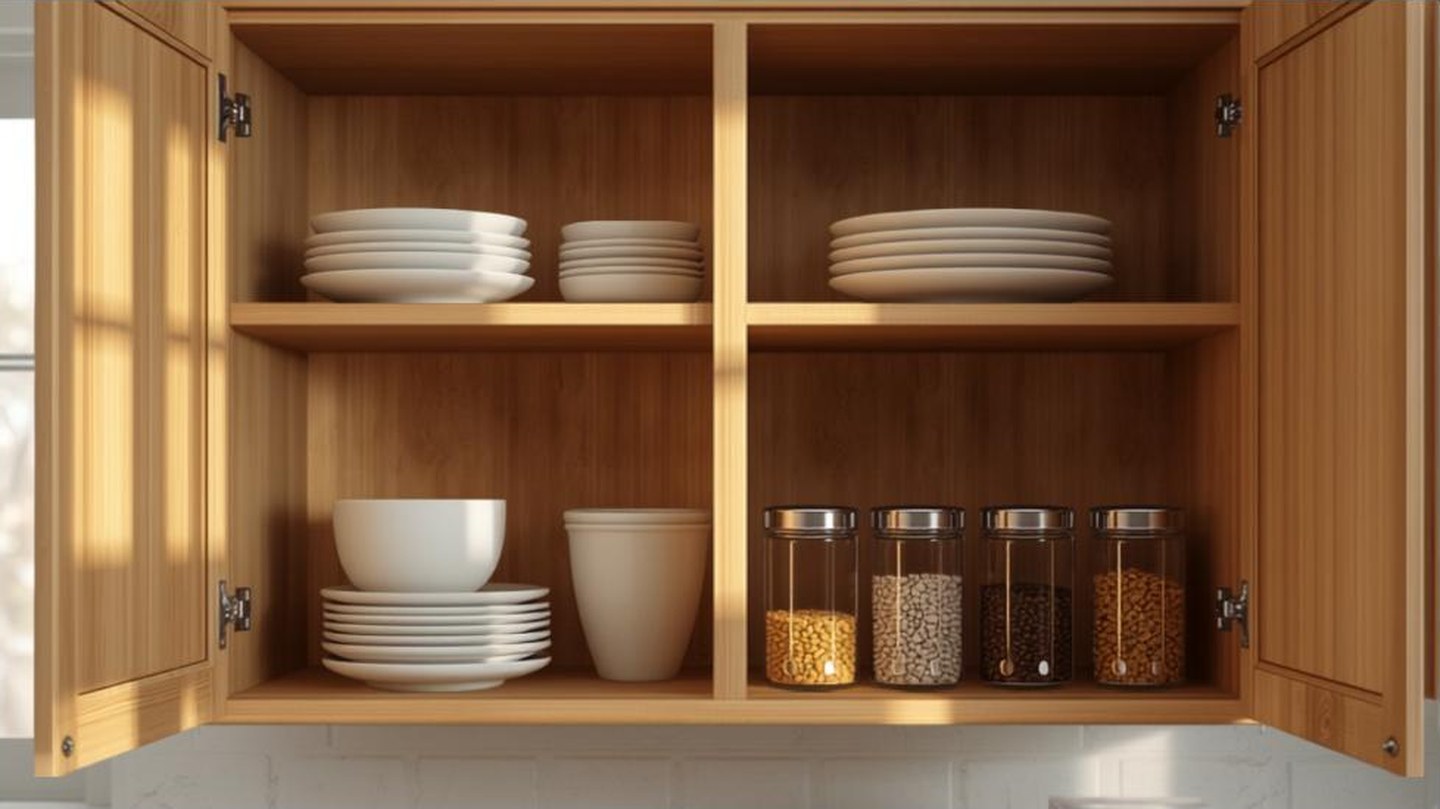
Open most small-kitchen cabinets and you'll find the same thing. A stack of plates with a foot of empty air above it. Cans buried three-deep where you can't see the back row. An under-sink cabinet that's become a graveyard of half-used sprays around the pipes. The problem usually isn't too few cabinets. It's that each one wastes most of its own volume, and a fixed shelf gives you no way to reclaim it. That's what organizers fix, with no renovation and nothing permanent.
To get more from small-kitchen cabinets, go after two things: the wasted air above your shelves and the deep back rows you can't reach. Risers and stacking shelves tier the dead vertical space; pull-out trays and turntables bring the back to the front; a plumbing-friendly organizer rescues the under-sink cabinet; and door racks turn a flat unused surface into storage. Start with the cabinet that frustrates you most, usually under the sink or the one with tall empty space above the dishes.
Use the air above your shelves
A short stack of plates or a single row of cans leaves inches of air above it that the fixed shelf can't reach. A riser adds a second tier over your plates or mugs. A stacking shelf lets you park a row of cans up top and another below in the same slot. It's the same principle as everywhere else in a small home, go vertical, just inside a cabinet. A couple of risers turn one crowded shelf into two, which is about the cheapest square footage in the kitchen.
Reach the back of deep cabinets
Whatever lands at the back of a deep cabinet goes invisible, so you really only use the front third. A pull-out cabinet drawer (a sliding tray that sits on the shelf) glides the whole contents forward, so the back row is one tug away instead of a full unpacking. A turntable (lazy Susan) does the same for jars, oils, and condiments: spin it and the back comes around. Corner cabinets, the worst offenders, are exactly where a turntable earns its keep. Both drop in with no install.
Tame the under-sink cabinet
An awkward box with pipes running through it, and prime real estate going to waste. The fix is an organizer built to work around the plumbing: a two-tier expandable rack with legs that straddle the pipes, or pull-out bins that slide past them. Add a tension rod across the front to hang spray bottles by their triggers, which clears the cabinet floor, and hooks inside the door for brushes and gloves. Now you can see the dish soap instead of excavating for it.
Put the cabinet doors to work
The inside of a cabinet door is a flat vertical surface doing literally nothing, which makes it the highest-return few dollars in a cramped kitchen. An over-the-door or adhesive rack turns it into a home for the flat things that always sprawl: pot lids (which never stack), cutting boards, foil and wrap boxes, a row of spices. Under the sink it holds sponges; by the trash, the bag roll. One check before you load it up: make sure the door still shuts.
Corral cans, spices & the pantry cabinet
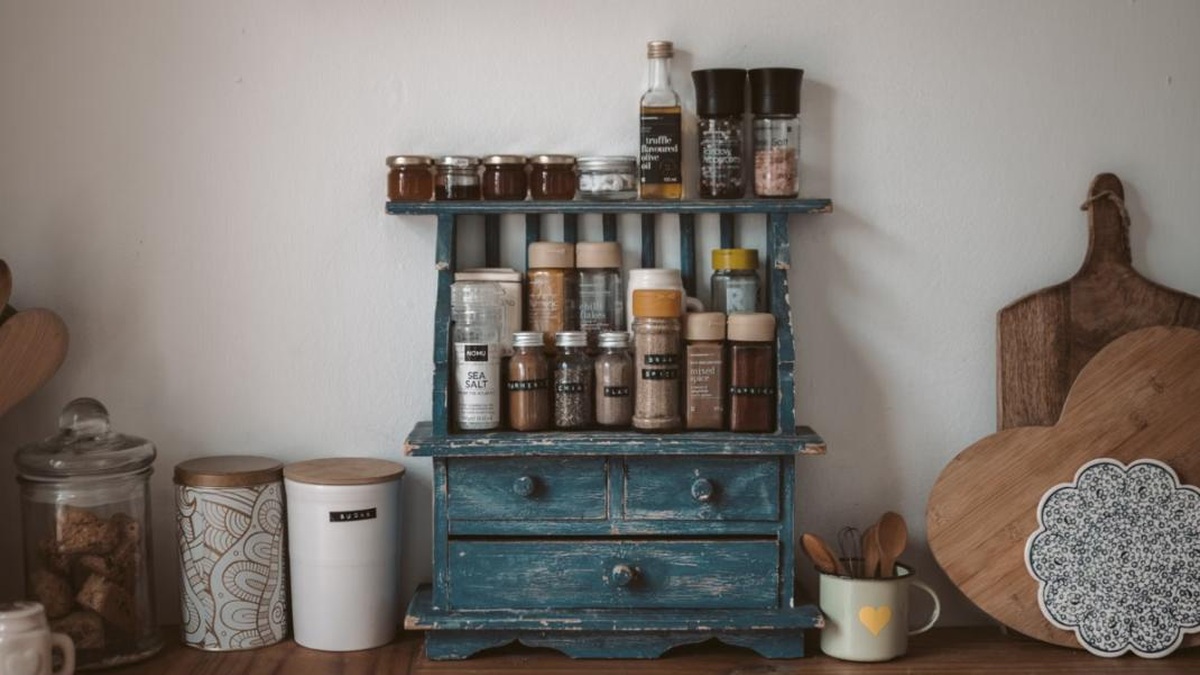
No pantry? Then one cabinet has to be it. A tiered can rack or dispenser shows the whole stock at a glance instead of hiding a back row. A stepped spice shelf or in-drawer insert ends the rummage through a jumble of jars. Clear stackable bins group snacks, baking supplies, or grains so a category pulls out as a unit. The goal is a cabinet that reads like a small store shelf, which is also how you stop buying a third jar of cumin you didn't know you had.
Common cabinet-organizing mistakes
Three to avoid. Buying before measuring. Interiors and the gaps around under-sink pipes vary a lot, so measure width, depth, height, and pipe positions before ordering, or you'll be shipping organizers back. Organizing without curating. No rack fixes a cabinet crammed with duplicate gadgets and expired cans, so thin the contents first, then size the organizers to what's left. And treating risers as an afterthought when the vertical air is the biggest single waste, so they're the first buy, not the last.
Common questions
Do cabinet organizers really double your storage?
It depends how much dead air you're starting with. A cabinet with a short stack under a tall shelf can genuinely come close to doubling once you tier it; one that's already packed floor to shelf won't gain as much, because there's less wasted volume to recover. The deep-cabinet fixes add reachable space rather than new space, but reachable is the space you actually use.
Are these renter-safe, or do they need drilling?
Nearly all of it is drop-in: risers, pull-outs, turntables, and under-sink racks just sit in place. The only pieces that touch the cabinet are door racks, and the over-the-door and adhesive versions leave no holes. With adhesive mounts, check the weight rating before you hang heavy lids.
What should I buy first for the biggest payoff?
The cabinet that annoys you daily, then a couple of risers, since they cost the least per inch of space recovered. From there, work down to the deep cabinets and the under-sink box, which take a bit more measuring but reclaim the most hidden volume.
Our product picks
SONGMICS Cabinet Shelf Risers (Set of 4)
Add a second tier over plates, mugs, and cans to use the empty air above them. About the cheapest way to turn one crowded shelf into two, and it needs no tools.
Check price on Amazon →Pull-Out Cabinet Organizer, 21" Deep (2-Pack)
Sliding trays that glide the whole shelf forward so the back row is one tug away instead of a full unpacking. Drop-in and no-install, and they turn deep dead cabinet space into storage you'll use.
Check price on Amazon →Expandable 2-Tier Under-Sink Organizer
Expandable racks with legs that straddle the pipes, turning the awkward damp cabinet into a two-level, see-everything system. Add a tension rod to hang the spray bottles above it.
Check price on Amazon →Go cabinet by cabinet and a small kitchen feels like it grew, no renovation required. For the counters and the space between the cabinets, pair this with our guide to a tiny kitchen with no counter space.