Stand in a small kitchen mid-recipe and the problem announces itself. There's nowhere to put the cutting board while the pan is on, nowhere to set the colander, nowhere to stage the four things you're about to chop. Cabinets usually aren't the shortage. Counter is. A kitchen cart drops a second work surface exactly where you need it, then wheels away when you'd rather have the walking space. Buy the right one and a galley kitchen finally gives you room to work. Buy the wrong one and you've parked a bulky island in the path you use forty times a day. Here's how to tell them apart.
The best kitchen cart is a rolling one with locking casters, a butcher-block or stainless top for prep, and at least one shelf or drawer underneath, sized to tuck against a wall or under a counter overhang when you're not using it. Care more about the top surface and the wheels than the number of shelves, and measure your clearances before anything else.
Why a cart beats a fixed island
A built-in island is a fantasy for most small kitchens. Designers work to roughly 36 to 42 inches of walking space around a fixed island, and a lot of apartment kitchens simply don't have that to spare, so a permanent block in the middle means squeezing sideways to reach the fridge. A cart sidesteps the whole problem by not being permanent: roll it out to prep, lock the wheels, roll it back when you're done, and the floor is only spent during the twenty minutes you're actually cooking.
That mobility does more than save space. Next to the stove it's a landing zone for hot pans; by the sink it holds the drying rack; pushed to the doorway during a dinner party it's a drink station. One piece of furniture, three jobs, none of them costing you floor the rest of the time. For a renter that's the whole appeal: island function with zero installation, and you take it with you when you move.
Butcher-block prep carts
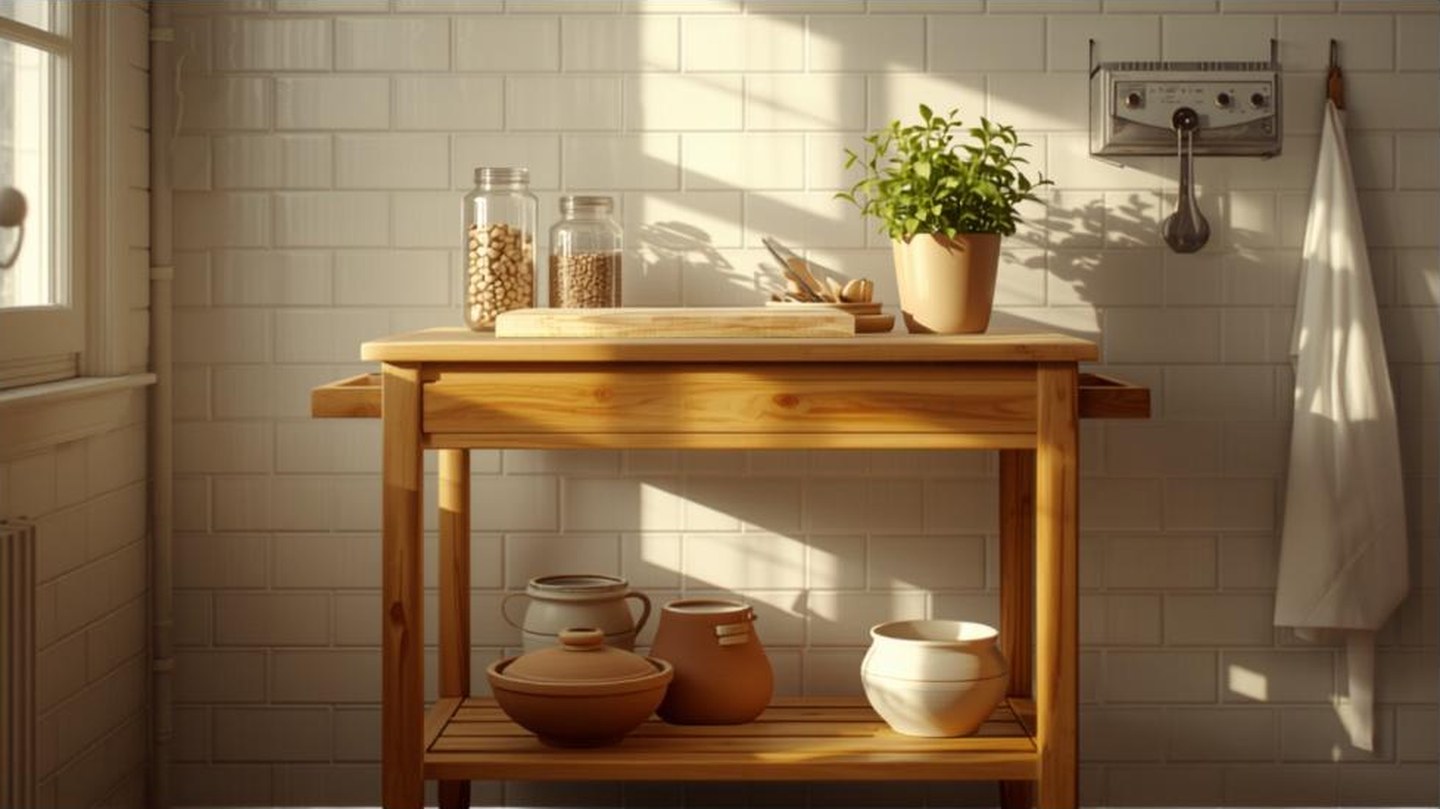
If you actually cook, start here. A butcher-block cart tops a rolling base with a thick slab of hardwood you can chop directly on, which turns the cart into genuine extra prep counter instead of a shelf with a lid. The wood is kind to knife edges, takes the heat off a hot pan in a pinch, and looks warm and intentional rather than like storage you're apologizing for. A good one adds a drawer for knives and an open shelf or two for a stand mixer, bowls, or the pots that never fit in a cabinet.
The trade-off is weight and care. Solid hardwood is heavy, which steadies it under a knife but means you want smooth casters so it still rolls easily, and the top needs a wipe of food-safe oil now and then to keep from drying out. The good ones aren't cheap, so treat it as furniture you'll keep. For a kitchen where the counter runs out the second you unpack the groceries, it's the single most useful thing on this list.
Stainless steel & wire carts
Want a lot of function for the money and don't care about the farmhouse look? Go commercial. A stainless prep cart or a chrome wire shelving unit, the kind you see in restaurant kitchens, gives you a wipe-clean, heat-proof, hard-wearing surface and plenty of shelf capacity for a low price. Wire shelves adjust, so you can set one level for small appliances and another for tall bottles, and the open design keeps the cart from reading as a heavy block in a tight room.
The honest downside: a wire top isn't a prep surface. Things tip, small items fall through, and you can't chop on it. The fix is a cheap cutting board or a bamboo shelf liner that turns the top tier into a flat work zone. Do that and it's the value pick, the one to grab for the most usable storage and surface per dollar.
Narrow & slim-profile carts
Some kitchens don't have room for a cart in the middle at all. They have a gap: the 9-inch slot beside the fridge, the dead space at the end of a counter run, the few inches between stove and wall. A slim rolling cart (sometimes sold as a gap cart) is built for exactly these, a tall narrow tower on wheels, often just wide enough for cans and spice jars, that slides into a space you were writing off. Pull it out, take what you need, roll it back flush.
This isn't a prep cart; the top's too small to work on. But as a pantry it stores food in space that was doing nothing, which makes it some of the best-used square footage in the room. In a kitchen with no pantry closet, one or two beside the fridge hold a surprising amount of dry goods. If your shortage is storage more than surface, start here.
Drop-leaf & folding carts
The most space-efficient carts do the disappearing-table trick. A drop-leaf cart has a hinged flap on one or both sides: fold it down and the cart is a slim tower against the wall, fold it up and you've got a surface big enough to plate a meal or roll dough. A few fold nearly flat and slide into a closet, about as close to counter space you can put away as furniture gets.
You give up a little rigidity for the hinges, so these suit lighter prep (plating, staging, mixing) more than heavy pounding or breaking down a chicken. But for a true studio galley where the cart has to vanish between uses, a folding or drop-leaf model is the only style that truly clears out. Add a couple of hooks on the side for towels and mugs and it earns every inch.
How to size one for your kitchen
Measure before you fall for a photo. Three numbers decide whether a cart helps or haunts you. The parked footprint: where does this live the 23 hours you're not cooking? Measure that wall or overhang and buy to fit, because a cart with no home just becomes an obstacle. The doorway and path width: it does you no good if it can't roll from its parking spot to the stove without scraping past the oven door. And the working height: aim for close to counter height, roughly 34 to 36 inches, so it reads as a continuation of your workspace instead of a too-low table you hunch over.
Then match the style to your actual shortage: short on surface, buy for the top; short on storage, buy for the shelves or go slim-and-tall to mine a gap; short on both and short on room, a drop-leaf splits the difference. Whatever you pick, insist on locking casters, because a cart that skates away while you're pressing down on a knife is worse than no cart at all. It's the same logic behind choosing a space-saving dining table: size for the footprint you live with daily, not the one you use occasionally.
Common kitchen-cart mistakes
A few people learn the hard way, all variations on the same theme: mobility over capacity. Buying six shelves you can't roll anywhere. Skipping the caster locks and turning a prep surface into a moving target. Ignoring the top material, then discovering you can't actually work on a wire grid. And not planning where it parks, so a genuinely useful cart lives in the walkway and everyone resents it. Sketch the parking spot before you buy, not after.
Common questions
How much counter space does a kitchen cart actually add?
Roughly two to four square feet of usable surface, depending on the model, enough to stage an entire recipe's worth of prep or hold the appliances that never fit on your counter. In a galley kitchen where you're working on a single strip, that can change how the whole space functions more than any cabinet reorganization.
Is a rolling cart stable enough to chop on?
With the casters locked, yes, especially a heavier butcher-block model, whose weight works in your favor under a knife. Lighter wire and folding carts can shift or flex if you really lean in, so keep the aggressive chopping to a solid-top cart and use the flimsier ones for staging and plating. Check that all four wheels lock, not just two; two-wheel locks still let the cart pivot.
Can a kitchen cart hold a heavy appliance like a stand mixer or microwave?
Most can, but check the per-shelf weight rating and keep the heavy item on a lower shelf so the cart doesn't get top-heavy and tippy while rolling. A stand mixer parked on an open bottom shelf is a classic use; a microwave works too, just leave clearance around the vents and don't run it mid-roll.
Our product picks
Rolling Kitchen Island Cart with Wood Top
Thick hardwood top you can chop directly on, plus a drawer and open shelves below. Warm-looking and genuinely useful, and the pick if you cook and keep running out of counter. Get one with locking casters, and expect to pay more than you would for a wire cart.
Check price on Amazon →Stainless-Steel NSF Prep Table (Commercial-Grade)
Wipe-clean, heat-proof, and loaded with shelf space for a low price. The top isn't for chopping, so add a cutting board. Do that and it's hard to beat per dollar.
Check price on Amazon →Pipishell 3-Tier Slim Rolling Cart
Tall and narrow enough to slide into the dead space beside the fridge or stove. A rolling pantry that stores canned goods and spices in room that was doing nothing. Buy two if you have no pantry closet.
Check price on Amazon →Match the cart to your actual shortage, then measure the parking spot and the path to the stove before you buy. Get it right and the counter you always wished you had just rolls up next to you.