A full-size dining table is one of the biggest pieces most small apartments can't really justify. It takes up a quarter of the floor so you can use it for twenty minutes twice a day, and the rest of the time it's a mail pile you eat next to. The fix isn't skipping a table. It's buying one built to change size: big enough to feed people when they come over, small enough to fade back the other 23 hours. Four styles pull that off, and which one fits comes down to how you actually eat.
The best space-saving dining table depends on your room: a drop-leaf folds its sides down to a slim console against the wall; an extendable starts compact and pulls out for guests; a wall-mounted fold-down clears off the floor completely between meals; and bistro or nesting sets tuck away when the floor matters more than the seating. Measure your smallest configuration first, because that's the footprint you live with daily.
Drop-leaf tables
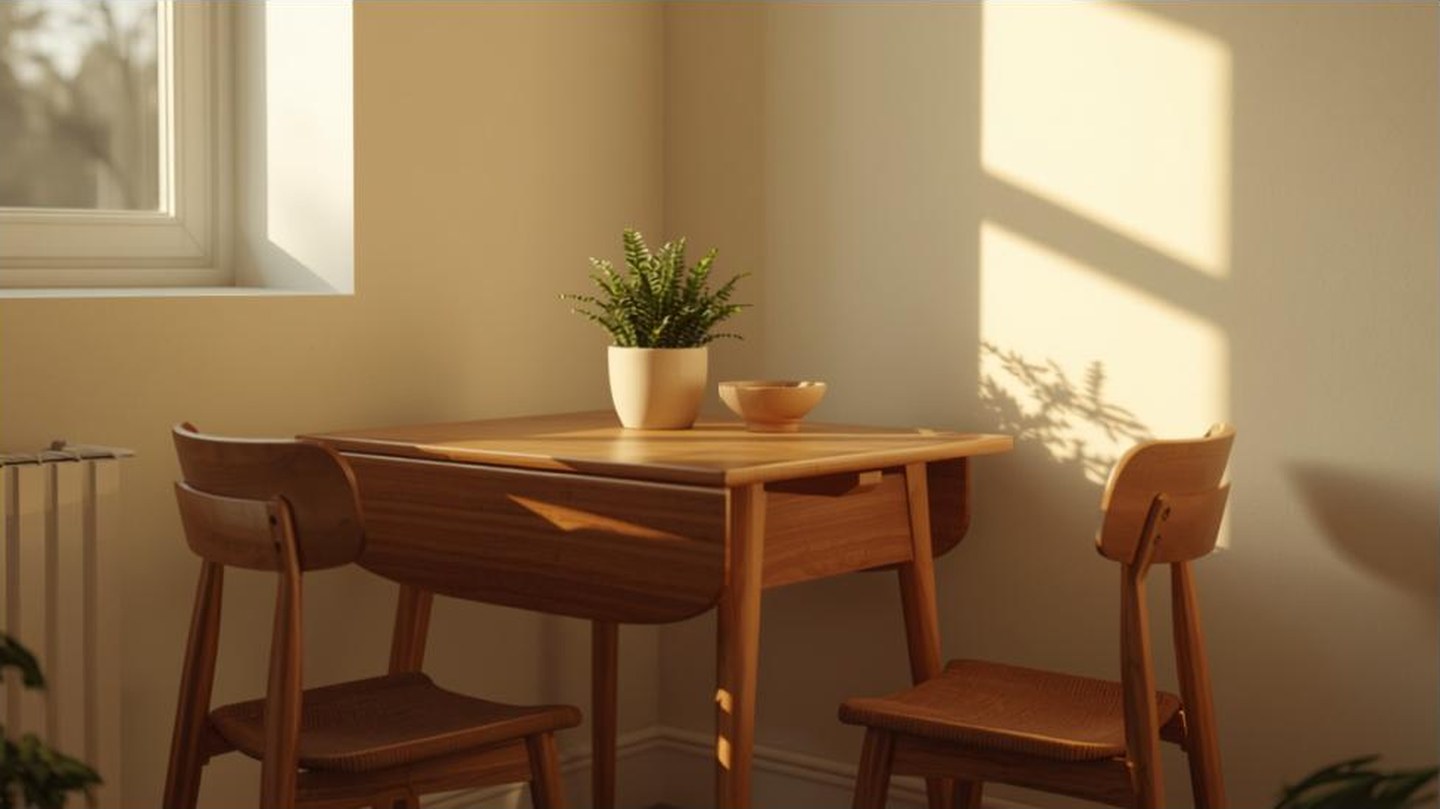
The oldest small-space trick in the book, because it works. One or both sides of the top are hinged; fold them down and a four-seater becomes a narrow console flat against the wall, fold them up and you're back to a real table in five seconds with no leaves to store. The best versions have a gate-leg or a bracket that swings out to hold the raised side, so it's solid under a plate rather than wobbly. Watch the folded-down depth: a good one collapses to around ten to fourteen inches, shallow enough to walk past without turning sideways. This is the pick if two people eat daily, four occasionally, and you'd rather the table live out as a slim surface than get stowed.
Extendable tables
An extendable table does the opposite of a drop-leaf: it starts as the compact table you use every day and grows when you need it. Some hide a leaf you insert by pulling the halves apart; the cleverest are console-to-dining tables that live as a skinny hallway console barely a foot deep, then unfold and lock into a table seating six or eight. That's the most capacity you'll get per inch of everyday footprint. The trade-off is the mechanism: more moving parts means more that can loosen or stick over years, so buy a sturdy one rather than the cheapest, and expect to pay more up front. If you host more than the occasional guest but won't give up the floor daily, nothing else matches its range.
Wall-mounted fold-down tables
When every square foot is spoken for, a true studio, a galley kitchen, a balcony you eat on, this is the most complete disappearing act. A tabletop hinged to a wall bracket or slim cabinet lifts up to eat and folds flush when you're done, reclaiming the floor entirely; some models are barely thicker than a picture frame closed. Pair it with folding or stacking chairs and the dining area clears out on demand. The catch is installation: most anchor into wall studs to safely hold weight, so it suits a place you'll stay in more than a short rental. Can't drill? A slim folding table you tuck behind a door gets you most of the way with none of the hardware.
Want the exact plans to build these?
A library of 16,000+ step-by-step woodworking plans — shelving, storage beds, fold-down desks, and space-savers with cut lists and diagrams for every skill level.
See the plans →Bistro & nesting sets
Sometimes the right answer is simply small and movable. A two-person bistro set, a compact round table with a pair of chairs, is the least fussy option and slides out of the way when you need the floor. Nesting versions go further: the chairs tuck fully under and the whole set pushes into a corner, reading as a single small piece until you pull it apart. A round top matters more here than people expect. With no corners to catch a hip, it takes up less visual and physical space and seats the same number in a smaller diameter. If your dining needs top out at two, don't overbuy; a bistro set leaves you the most open floor of anything here.
How to choose for your space
Start from how you actually eat, not how you wish you entertained. Everyday two-top? A bistro set or drop-leaf keeps your floor open. Regularly go from two to six? The extendable console earns its mechanism. Need the table gone entirely so the room can become a workout spot or play area? Only the wall-mounted fold-down truly clears out.
Then measure twice: the closed footprint, because that's what you live with daily, and the open clearance, so pulled-out chairs don't block the only path to your kitchen. A table that turns your walkway into an obstacle course at every meal defeats the whole point of buying small, so sketch the pulled-out footprint on the floor before you order.
Common small-table mistakes
Three that trip people up. Sizing for the dinner party you host twice a year instead of the two-person meal you eat daily; size for the everyday number and let the expansion handle the rest. Forgetting the chairs. A table that folds flat next to four bulky chairs you can't store hasn't saved much, so plan folding or stackable seating alongside it. And skimping on the moving parts. On anything that folds or extends, the hinge, gate-leg, or slide is what fails first, so a flimsy mechanism is a wobbly table within a year, not a bargain.
Common questions
Which of these work in a rental without drilling?
All but one. Drop-leaf, extendable, and bistro or nesting sets are freestanding and need no hardware. Only the wall-mounted fold-down usually anchors into studs; if you can't drill, a slim folding table stored behind a door is the renter-safe stand-in.
How many people can a small table actually seat?
More than the footprint suggests. A 36-inch round comfortably seats four, and a console-to-dining table that lives a foot deep opens to six or eight. Buy for the two-top you eat most nights and let the leaves cover the rare crowd.
Are round or square tables better for small spaces?
Round, usually. No corners to bump means it eases traffic and seats the same number in a smaller diameter. A single pedestal base helps more still, since chairs slide under from any side instead of fighting four corner legs.
Our product picks
36" Round Drop-Leaf Dining Table
Folds to a slim console against the wall, opens to a real four-seater in seconds. The most practical pick if two people eat daily and guests come occasionally.
Check price on Amazon →Mobili Fiver Easy Extendable Console Table
Lives as a foot-deep hallway console, unfolds to seat six or eight. The most capacity per inch of everyday footprint. It costs more and has moving parts, so buy a sturdy one.
Check price on Amazon →HOOBRO Wall-Mounted Fold-Down Table
Lifts up to eat, folds flush to the wall when you're done, clearing the floor completely. Pair with folding chairs. Anchors into studs, so it's for a place you can drill.
Check price on Amazon →Match the table to how you really eat, then measure both footprints before you buy. The right one gives you a proper table when you want it and your whole room back when you don't.