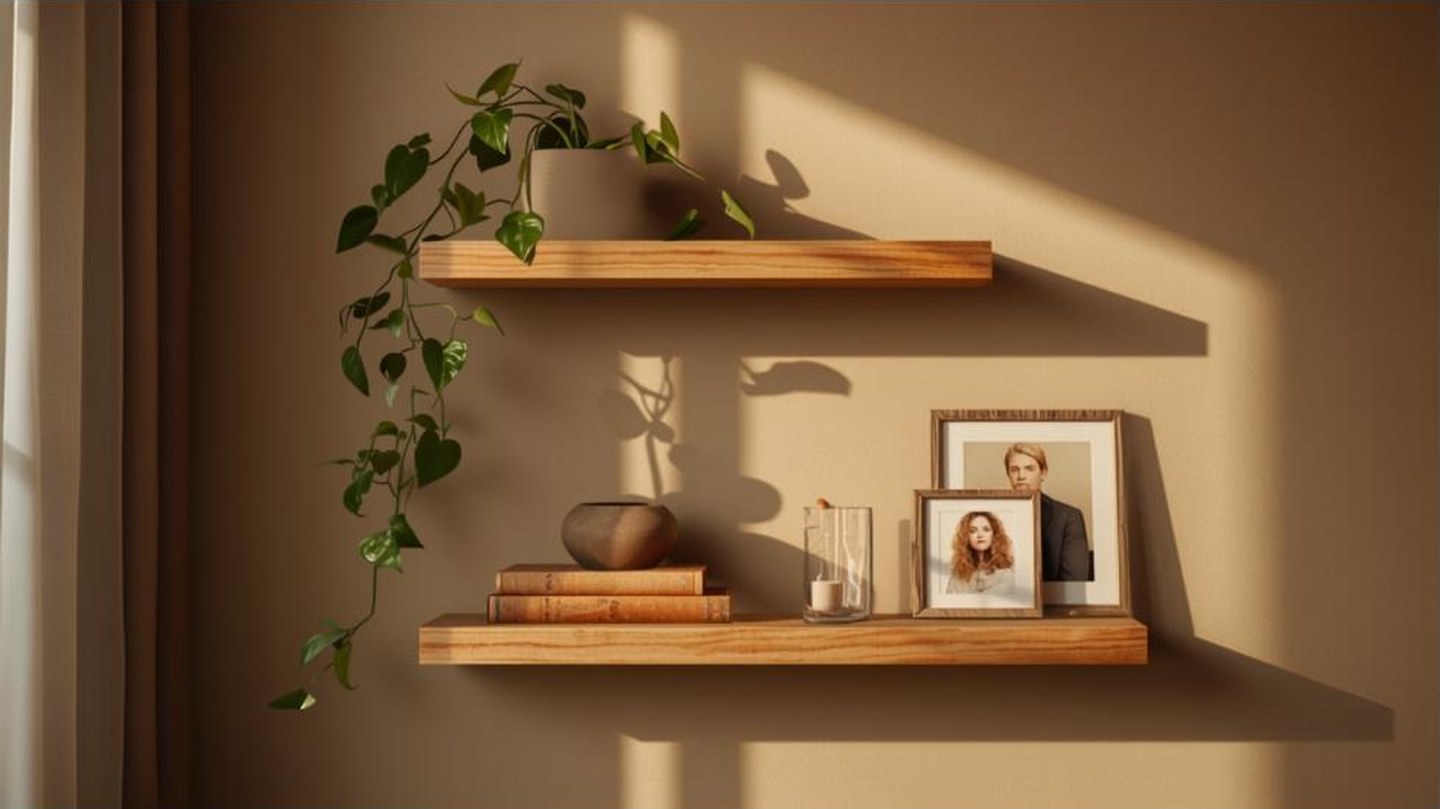
Every small apartment has the same untapped acreage: the walls. You step around a bookcase that eats two square feet of floor while eight feet of empty wall sits above it doing nothing. Floating shelves flip that math. They mount flush with no visible brackets, no legs, no footprint, just a plank that looks like it's hovering, holding the books, plants, and glasses that are currently colonizing your counters. Here's how to pick the right style, hang it so it actually holds, and decide whether to buy or build.
The best floating shelves are solid-wood or thick engineered planks on concealed steel brackets, anchored into studs and rated for the weight you'll actually load. For books and dishes, that means a shelf at least 1.25 inches thick on a floating-bracket rod, hitting the studs. For lighter display in a rental where you can't drill, a slim shelf on damage-free hardware is enough. Match the mounting to the load, not the look.
Why vertical storage wins in a small space
Floor space is the currency of a small apartment, and freestanding furniture spends it fast: a bookcase claims its full footprint whether it holds forty books or four. Shelves cost you nothing on the floor, and they draw the eye up, the same trick behind hanging curtains high to make a room look bigger, so a low-ceilinged studio feels less boxed in.
There's a function win too. Shelves put things at eye level and within reach: the mugs you use daily, the cookbook you actually open, the plant that needs light. In a place where every horizontal surface is under siege, moving storage up onto the walls is one of the highest-leverage moves you can make, and floating shelves are the least bulky way to do it.
Solid-wood floating shelves
The workhorse of the category. A solid-wood shelf (oak, walnut, pine, or a thick veneered board) rides a concealed metal bracket that slides into holes drilled in its back edge, so from the front you see only clean wood floating off the wall. Buy this style for anything with real weight: books, plates, a row of full mason jars, a small speaker.
The reason it beats the cheapest particleboard is sag. Particleboard and thin MDF creep, bending slowly under sustained weight and never springing back, so the shelf you loaded six months ago now droops in the middle. Solid hardwood or a quality thick-core board holds its line for years. Thickness is the tell: an inch and a quarter or more won't bow where a thin decorative plank will. If you buy one style, buy this one.
Corner & L-shaped shelves
Corners are some of the most wasted real estate in a small apartment, the spot where two walls meet and no normal furniture fits cleanly. A corner floating shelf, or an L-shaped shelf that wraps an inside or outside corner, mines that dead angle. Inside-corner shelves work well above a desk or in a galley kitchen for spices and oils. Outside-corner wraps soften a hard edge and give a plant a home where a rectangular shelf would jut into the walkway. Stack two or three up a corner and you've built a slim display tower that costs zero floor.
Renter-friendly, no-drill shelves
If your lease makes you flinch at the word "drill," you just change the hardware. Damage-free mounting has gotten genuinely good: heavy-duty adhesive strips hold a real amount of weight when you follow the rating and prep the wall, and slim shelves built for them carry a few books or a cluster of decor without a single hole. The catch is being honest about load; these are for display, plants, a paperback or two, not a full row of hardcovers. For more capacity without drilling, lean on structure you're allowed to use: a tension-rod shelf between two walls of an alcove, or shelves on a leaning ladder frame that needs no anchors at all. Our guide to renter-friendly upgrades that don't lose your deposit covers the no-drill toolkit in depth.
Building your own (cheaper and exactly your size)
A store shelf is a plank plus a hidden bracket plus a markup. Buy a length of solid hardwood, cut it to fit, drill it for a floating-bracket rod (or build a simple hollow "box" shelf that slides over a wood cleat screwed to the studs), sand, finish, and you've made something sturdier than a lot of what's on the store shelf, for close to the price of the board, in exactly the length your wall needs. The cleat-mounted box shelf in particular is close to foolproof and carries serious weight, because the load rides on a bar screwed straight into your studs. The visible plank is the easy half; it's the cleat geometry and stud-anchoring that decide whether the shelf holds a library or peels off, which is exactly where a tested plan pays for itself.
Want the exact plans to build these?
A library of 16,000+ step-by-step woodworking plans — shelving, storage beds, fold-down desks, and space-savers with cut lists and diagrams for every skill level.
See the plans →How to hang them so they hold
This is where most floating shelves fail, so slow down. The single rule that matters most: find the studs and anchor into them for anything with real weight. Drywall alone, even with plastic anchors, is not to be trusted with a loaded book shelf; it holds until it doesn't, and it fails all at once. Studs usually sit 16 inches apart on center, and a cheap stud finder locates them in seconds. When a stud isn't where you need the shelf, use the right anchor for the wall (toggle bolts or heavy-duty self-drilling anchors for drywall, masonry anchors for concrete or brick) and rate your load down. Two more: use a level so a loaded shelf doesn't tilt and slide your jars to the low end, and mind depth, because a shelf past about ten inches puts heavy leverage on the bracket and wants a thicker rod and solid stud anchoring.
Common floating-shelf mistakes
The failures cluster around a few repeat offenders, each the flip side of a rule above. Trusting drywall anchors with a book load (hit the studs). Buying a shelf too thin for the weight (it bows within months). Overloading no-drill hardware (respect the rating instead of testing it). Going deep without upgrading the bracket (the leverage invites a pull-out). And skipping the level (a shelf a hair off looks wrong the moment anything round sits on it).
Common questions
How much weight can a floating shelf hold?
It depends almost entirely on the mounting, not the shelf. Anchored into studs with a solid steel bracket or a screwed-in cleat, a good shelf holds 40 to 75 pounds or more, enough for a full row of books. Into drywall with plastic anchors, that same shelf might safely carry 10 to 20 pounds before the anchors start to creep, and no-drill adhesive shelves are usually rated for just a few pounds. The material sets whether it sags over time; the anchoring sets whether it stays on the wall at all.
How far apart should floating shelf brackets be?
Line the brackets up with your studs, which puts them about 16 inches apart on most walls, and let the shelf overhang no more than a few inches past the outer bracket on each end. A long shelf spanning three studs beats a shorter one hung between studs on anchors, since every additional bit of unsupported length is where the sag and the droop show up first.
Is it cheaper to build floating shelves than buy them?
Often, yes, because a retail shelf is mostly markup on a plank and a hidden bracket. Your cost building one is largely the board and the hardware, and you get the exact length your wall needs. The one place to invest is a real set of plans for the concealed cleat or bracket, since that's the part carrying the weight.
Our product picks
BAYKA Rustic Wood Floating Shelves (Set of 3)
Thick real-wood shelves on concealed steel brackets, the style that holds books and dishes without bowing. Buy the thickest you can and anchor into studs. The one to get if you're only getting one.
Check price on Amazon →Round Corner Floating Shelves (Set of 4)
Turn a dead corner into a vertical display tower that costs zero floor. Handy above a desk or in a galley kitchen. Stack two or three to draw the eye up the room's most-ignored angle.
Check price on Amazon →Command Display Ledges (No-Drill)
Slim shelves on heavy-duty adhesive mounts: real wall storage for plants and decor with no holes to spackle. Respect the weight rating and keep the load light. These aren't for a row of hardcovers.
Check price on Amazon →Put your storage on the walls and the clutter crowding your floors and counters moves up into space that was doing nothing. Buy solid wood for the heavy stuff, mine your corners, and hit the studs. Do that and a floating shelf holds for as long as you live there.