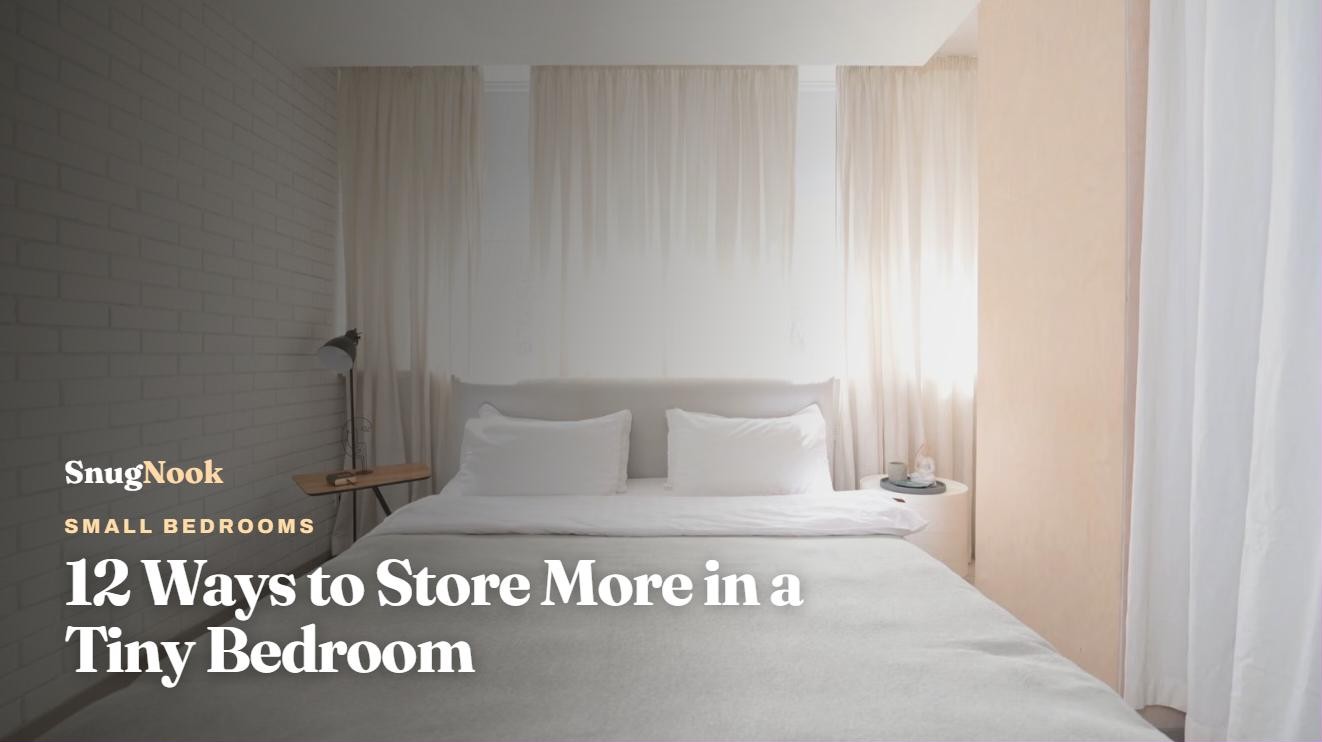
A small bedroom has a particular problem the rest of the apartment doesn't: the single biggest object in the room is a mattress you can't shrink, can't stack, and can't move around much. It sits in the middle of the floor taking up half the square footage, and it does nothing but hold you at night. Everything else — clothes, books, the stuff that won't fit in the closet — has to find a home in what's left. The good news is that a bed this size is hiding a lot of usable space, and the walls above it are almost always empty. Once you start treating the bed as furniture with storage inside and under it, and the walls as shelving you haven't installed yet, a cramped bedroom starts holding a surprising amount.
The fastest wins in a small bedroom are the space under the bed and the wall above it. Raise the bed and fill the clearance with rolling drawers, hang shelves and an organizer where nothing's mounted yet, and swap bulky furniture for narrow pieces that store more than they take up. Do those three and most small-bedroom crowding disappears before you've bought a single new dresser.
Mine the space under the bed
The flattest, most wasted surface in the room is the floor under your mattress, and it's usually just collecting dust and one lost sock. A standard bed frame sits with six to eight inches of clearance underneath — enough for a real drawer's worth of storage the length of the whole bed. Two moves unlock it.
First, if your frame is low, lift it. Bed risers raise the frame another three to eight inches for a few dollars, turning a shallow gap into a deep one. Measure the clearance you'll have after the risers before you buy bins, because the whole point is to fill that height exactly. Second, don't just shove duffel bags under there — use containers built for the space. Rolling drawers on casters slide out from the side for the things you reach for weekly; flat labeled bins hold the off-season stuff you touch twice a year; and a zippered bag crushes a spare comforter down to a third of its size. Our full breakdown of what fits which clearance covers the measurements in detail.
If you're buying a new bed anyway, skip the risers-and-bins route entirely and get a frame with drawers built in — see the furniture section below.
Go up the walls, not out
In a small bedroom you run out of floor long before you run out of wall. The space above the headboard, the space above the door, the strip of wall beside the bed where a nightstand can't fit — all of it is storage you haven't hung yet, and most of it goes in without waking the neighbors.
A floating shelf or two above the bed holds books, a plant, an alarm clock, the things a nightstand would otherwise carry — which means you can run a narrower nightstand, or skip it. Keep the lowest shelf high enough that you won't crack your head sitting up. On the back of the bedroom or closet door, an over-the-door organizer turns a flat slab into a column of pockets for shoes, accessories, or the small stuff that clutters a dresser top. And a row of adhesive hooks along an empty wall handles bags, hats, a robe, tomorrow's outfit — renter-safe and gone without a mark at move-out. Nearly everything in our renter-friendly wall decor guide doubles as bedroom storage when you hang function instead of art.
There's a bonus: getting things up off the floor and onto the walls makes the room read as bigger, because visible floor is what the eye reads as space. The same principle runs through making a small room look bigger.
Buy furniture that stores twice
The single best rule for furnishing a small bedroom: every piece should do its obvious job and hide storage. A bed is a bed, but a storage bed with built-in drawers is a bed plus a dresser in the same footprint — often four drawers that replace a chest of drawers entirely, which can be the difference between needing a dresser and not. If a full storage bed is out of budget, a simple platform frame with two drawers still reclaims the under-bed zone without risers or loose bins.
For clothes, think tall and narrow instead of wide and low. A narrow dresser or drawer tower stacks the same drawer capacity into a fraction of the floor a traditional dresser eats — you go up the wall instead of across it. Look for a footprint under sixteen inches deep so it doesn't crowd the walking path. And the bedside table is its own small puzzle, covered just below and in our roundup of the best nightstands for small bedrooms.
The mistake to avoid is buying a crowd of small pieces because "it's a small room." A single correctly-sized dresser beats three little bins stacked in a corner; a storage bench at the foot of the bed beats a chair that only holds laundry. Fewer pieces, each pulling double duty, always wins.
Squeeze more out of the closet
A small bedroom's closet is usually one rod over a mountain of dead air and dead floor — using maybe half its actual volume. You can roughly double the capacity without a single screw. A hanging rod doubler drops a second rod below the first so shirts hang over folded stacks; a hanging cloth shelf organizer clips onto the rod and turns vertical air into cubbies; and slim velvet hangers, at a third the thickness of the plastic ones, let the same rod hold far more. Down at the bottom, a couple of stacked bins or a shoe rack catch what's piling on the floor. Our closet organizer guide lays out the full no-install system.
No closet at all? That's common in older apartments and studios, and it's solvable with a freestanding wardrobe or a garment rack plus a narrow dresser — the same tall-and-narrow logic from the furniture section, just standing in for built-in storage.
Small-bedroom sizing chart
Before you buy anything, it helps to know the numbers that keep a small bedroom walkable instead of packed. These are the clearances we aim for in a tight room — tighter than a showroom will tell you, but livable:
| What | Aim for | Why it matters |
|---|---|---|
| Walking path around the bed | 24–30 in | Enough to pass and make the bed without turning sideways; 30 in feels open, 24 in is the floor. |
| Bed-to-dresser (drawers open) | 30–36 in | You need room for the drawer plus you standing in front of it. |
| Under-bed clearance (rolling bins) | 6–8 in | Below 6 in, most wheeled drawers won't fit; risers buy the difference. |
| Under-bed clearance (flat bins) | 4–6 in | Low-profile bins and bags slide into gaps a drawer can't. |
| Nightstand-to-bed gap | 0–2 in | Flush or nearly so, so you can reach a glass of water without leaning. |
| Nightstand height vs. mattress top | within 2–4 in | Level with the mattress reads right and is easiest to reach. |
| Narrow dresser depth | ≤ 16 in | Keeps it out of the walking lane along the wall. |
| Floating shelf height above mattress | 24+ in | High enough not to hit your head sitting up in bed. |
The one people get wrong most often is the drawer clearance — a dresser jammed 18 inches from the bed looks fine until you can't actually open the drawers and stand there at the same time. Measure the room with the drawers open, not closed.
The nightstand problem
In a small bedroom the nightstand is where the squeeze shows up most, because the gap between the bed and the wall is often just a foot or less. A standard nightstand won't fit, and the tiny table that does fit holds nothing. The fixes: go narrow (a bedside table under twelve inches wide still holds a lamp, phone, and book), go vertical (a taller, skinnier unit with two drawers stores more in the same floor), go floating (a wall-mounted shelf or cabinet uses zero floor and is renter-removable), or go without and let a floating shelf above the bed do the job. We compare the best options — narrow, floating, charging, and set-of-two — in the nightstands roundup; the top pick also appears below.
Common questions
How do I get more storage in a small bedroom without a dresser?
Go under the bed and up the walls first. Bed risers plus rolling under-bed drawers can hold a full dresser's worth of folded clothes, and a storage bed with built-in drawers replaces a dresser outright. Add a couple of floating shelves and an over-the-door organizer, and you may find you don't need the dresser at all. If you do, choose a tall narrow one over a wide low one to save floor.
What can I do if my small bedroom has no closet?
Stand in a freestanding wardrobe or a garment rack for hanging clothes, and pair it with a tall narrow dresser or drawer tower for folded items. Use the wall above both for shelves and hooks. It's the same tall-and-narrow approach you'd use with a closet, just providing the structure yourself — and most of it moves with you, which built-ins don't.
How much space do you need to walk around a bed in a small room?
Aim for 24 to 30 inches of clear path on the sides you use. Thirty inches feels comfortably open; 24 is about the minimum to pass and make the bed without turning sideways. You can push one side of the bed against a wall to give the walking room to the other side — a common and smart move in a truly tiny room.
Our product picks
Utopia Bedding Adjustable Bed Risers (4-Pack)
The cheapest square-footage you'll ever buy. Lift the frame 3–8 inches to open a deep under-bed zone for drawers or bins. Check the stated weight rating before you load it up.
Check price on Amazon →Yecaye Rolling Under-Bed Storage (2-Pack)
Casters mean you can pull them out from a low bed without a fight. Best for the clothes and shoes you reach for weekly; measure your clearance after risers first.
Check price on Amazon →LIKIMIO Platform Bed with 4 Storage Drawers
Four built-in drawers under the mattress can replace a chest of drawers entirely — a bed and a dresser in the same footprint. The highest-leverage single buy for a tiny bedroom.
Check price on Amazon →Tall Skinny Narrow Dresser Tower
Stacks a full dresser's drawer capacity into a fraction of the floor by going up the wall instead of across it. Look for a footprint under 16 inches deep so it stays out of the walking lane.
Check price on Amazon →Simple Houseware 24-Pocket Over-the-Door Organizer
Hangs on the bedroom or closet door with zero tools. Fill the pockets with accessories, small clothes, or shoes to clear the dresser top and floor.
Check price on Amazon →BREEZEHEAT Fluted Narrow Nightstand
When the gap beside the bed is barely a foot, a nightstand under about 12–16 inches wide still holds a lamp, phone, and book while two stacked drawers hide the clutter. See the full comparison in our nightstands roundup.
Check price on Amazon →Do the two big moves first — raise the bed and hang the walls — before you buy any new furniture. Most small-bedroom crowding is just floor and wall space sitting unused; once it's working, you'll know exactly which one piece is actually worth buying.