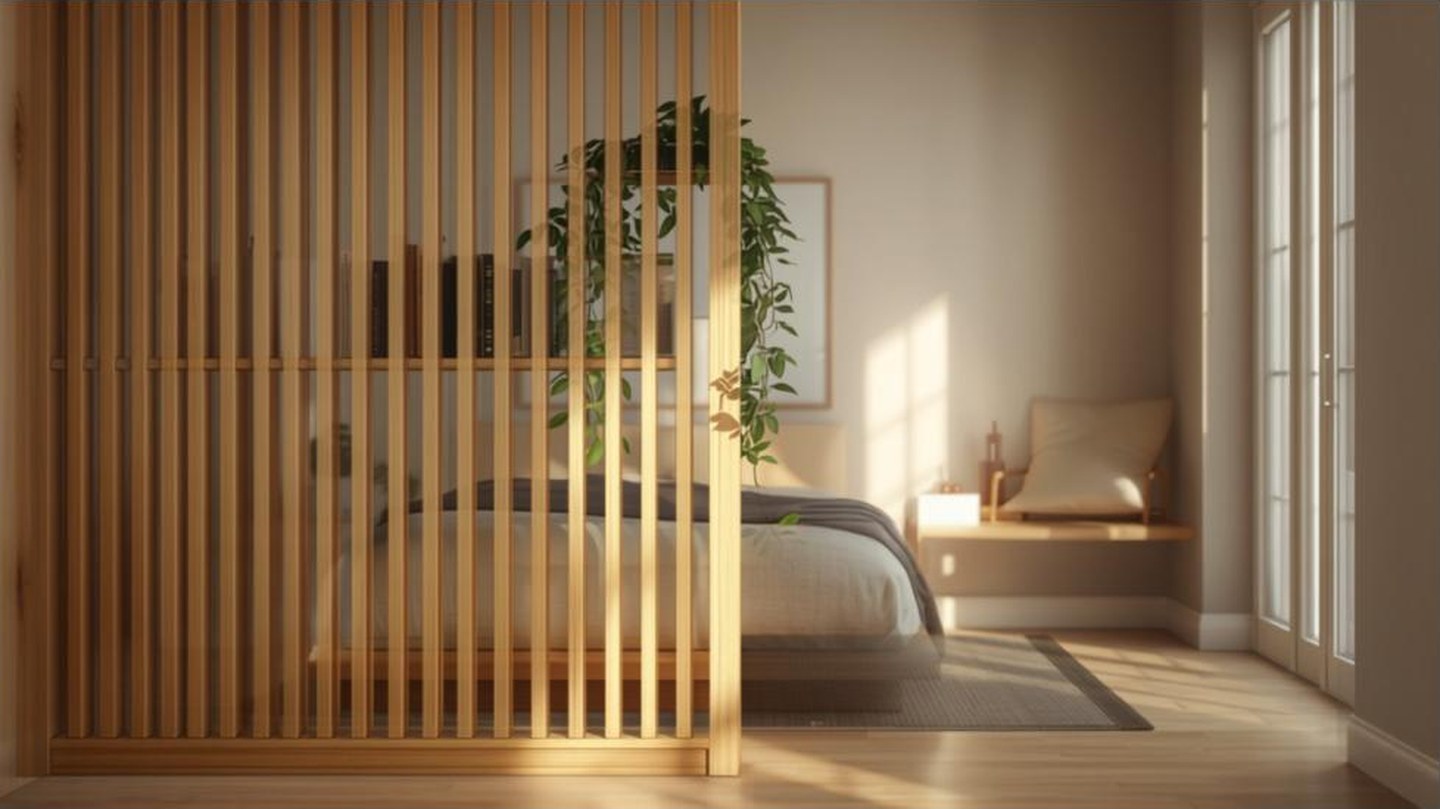
The hardest part of studio living is that everything happens in one room. You sleep, work, and eat inside the same four walls, and it starts to feel like you never leave the office. A room divider carves that space into zones: a bedroom separate from the couch, a work nook that isn't the dinner table. No stud, no permit, no lost deposit. It won't hand you a real second room, but it changes how the one room feels.
The right divider depends on the job: a folding screen for flexible, move-it-anywhere separation; an open bookcase when you want the divider to store things too; a curtain track for the most privacy around a bed. Separate the bed first, since sleeping next to your workspace is what makes a studio feel smallest.
Folding screens
A freestanding folding screen unfolds to block a sightline and folds flat against a wall when you want the room open. It's light, needs zero installation, and comes in everything from woven and airy to solid and opaque. Best for hiding a bed or a messy corner on demand. Know the limit: a screen blocks the view, not the sound. And a tall, lightweight one can tip if it's bumped, so keep it off high-traffic paths.
Bookcase dividers (double duty)
An open-back bookcase set perpendicular to the wall splits the room and gives you storage and display on both sides, so its footprint earns its keep twice. The open back lets light through, so neither zone feels boxed in. The catch is weight: anchor a tall unit with a tip-over kit or a discreet strap, especially one standing free in the middle of the room. In a rental you can usually screw into a single stud and patch the small hole at move-out.
Curtain dividers
A ceiling-mounted or tension curtain track draws a soft wall across the room, then pulls open to reclaim the space. Of the three, curtains give the most complete separation: full visual privacy for a sleeping zone, plus they take the hard edge off a room's echo. In a rental, a strong tension rod or heavy-duty removable adhesive brackets keeps it damage-free, though a heavy curtain may need actual screws to hold. Hang the panels floor to ceiling; anything shorter reads as an afterthought.
How to choose for your studio
Before you buy anything tall, measure two numbers: your ceiling height, which decides whether a track or full-height screen even fits, and the floor clearance your walkways need to stay open. A divider that turns the only path to the kitchen into an obstacle course defeats the point. And when you can only add one thing, put it around the bed. A sleeping zone that finally feels separate does more for a studio than screening off anything else.
Common divider mistakes
Two to sidestep. Solid, heavy pieces that wall off the light and leave the studio darker and smaller, so favor open or airy dividers unless you genuinely need blackout privacy. And a tall bookcase left unanchored in the open, which is a real tip-over hazard. Strap it and forget it.
Common questions
Will a room divider block sound between zones?
No. A screen or bookcase does nothing for noise, and even a heavy curtain only softens the echo. If sound is the real issue, layer in a rug, soft seating, or a white-noise machine, and save the solid, view-blocking divider for where you also want the room dark.
How tall does the divider need to be?
Tall enough to break the sightline from where you actually sit or lie. A divider you can see over from the couch isn't hiding much. Floor-to-ceiling curtains and full-height screens do the job; a waist-high piece just looks like furniture that wandered into the middle of the room.
Are room dividers renter-friendly?
The freestanding and tension-mounted kinds are. Folding screens and bookcases just stand there, and curtain tracks go up on tension rods or removable adhesive brackets. Only a tall bookcase really wants a screw into a stud for safety, and that's one small hole to spackle on the way out.
Our product picks
Dopinmin 4-Panel Folding Room Divider
Unfold to zone the room, fold flat when you want it open. No install, moves with you, airy or opaque. Just remember it hides the view, not the noise.
Check price on Amazon →6-Tier Geometric Bookcase Room Divider
Splits the room and adds storage on both sides while the open back keeps light moving. Anchor a tall one to a stud, since a freestanding unit can tip.
Check price on Amazon →Room Divider Curtain with Tension Rod
Draw a soft wall across the room for a private sleeping zone, then open it to reclaim the space. Go floor-to-ceiling. A heavier curtain may need screwed-in brackets.
Check price on Amazon →One divider won't turn a studio into a true one-bedroom. But drop it around the bed and the single room finally reads as two.