Look around any small room and you'll find the same wasted space: the corners. Awkward, hard to furnish, almost always empty, and so the biggest storage opportunity most people walk past every day. A corner shelf turns that dead diagonal into real storage and display without pushing into the floor you actually walk on. Here's how the main types compare, and why this is one of the more satisfying pieces to build yourself.
The best corner shelf depends on the corner: a tall tower or ladder for maximum vertical storage, floating corner shelves for display and light storage without touching the floor, and a corner desk or vanity when you want the corner to do a job. Start with your tallest empty corner. That's where you're wasting the most.
Why corners are prime real estate
The math on a small room is about usable floor, and corners barely count against it. A shelf or cabinet along a wall juts into the room and narrows your walking space. A corner unit tucks into a spot you can't walk through anyway, so it adds storage at almost no cost to how the room feels. There's a visual bonus too: a filled corner draws the eye outward and up, which makes the whole room read a little larger and a lot more finished.
Corner shelf towers & ladders
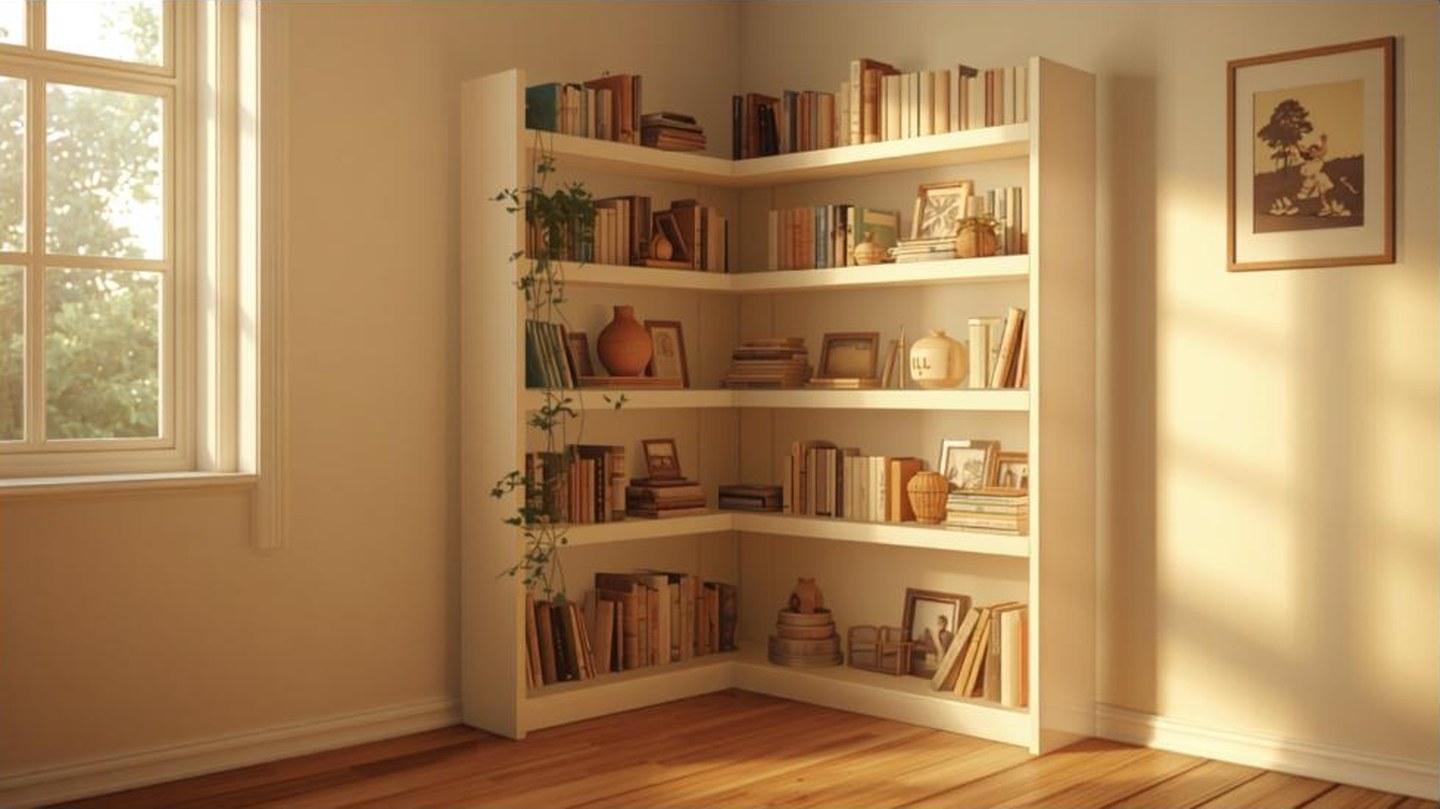
The maximum-storage option: a tall freestanding unit that climbs the full height of the corner for five or six tiers in a footprint about the size of a bath towel. Ladder versions lean in and taper as they rise, which keeps them from feeling bulky; boxier towers maximize shelf area. This is the pick when a corner needs to pull real weight, books, kitchen overflow, bathroom supplies, or a plant-and-decor display. Anchor it with a tip strap if it's loaded up high, especially in a bedroom or a home with kids.
Floating corner shelves
When you want display with nothing touching the floor, floating corner shelves are the answer. They mount into the corner and look like they're hovering, which is exactly what keeps a tight space feeling open. Hang them the rental-friendly way with damage-free anchors, or into studs for heavier loads. The trade-off is capacity: they hold less than a tower, so keep them to a plant, a few books, speakers, or bathroom bottles rather than heavy storage. Stack several up the corner and you've built a whole vertical display out of thin air.
Corner desks & working corners
Sometimes the best use of a corner isn't storage at all, it's function. A compact corner desk turns two walls of dead space into a real workspace, using the diagonal to give you more surface than the footprint suggests while the center of the room stays open. It's the same logic we cover in our tiny-apartment home office guide. A corner vanity, plant stand, or small cabinet applies the idea to getting ready or stashing one specific category of stuff. In a full small room the corner is often the only unclaimed spot left, so handing it a single job can solve a problem the rest of the room can't.
Build it yourself
Corner shelves are one of the friendlier entry points into building your own furniture. The shapes are simple, the pieces are small, and a unit or a set of floating shelves comes together with basic tools and a weekend, usually for less than a comparable store-bought piece. The real payoff is fit: if you've ever found that no shelf on the market suits your particular nook, this is the piece to make rather than buy. You also get to match the wood and finish to the rest of the room, so the corner reads as intentional instead of like a place you shoved a shelf.
Want the exact plans to build these?
A library of 16,000+ step-by-step woodworking plans — shelving, storage beds, fold-down desks, and space-savers with cut lists and diagrams for every skill level.
See the plans →Common corner-shelf mistakes
Three to avoid. Leaving the corner empty out of habit, which is the real headline: the most-overlooked storage in the room is the storage you never install. Under-strapping a tall unit loaded up high. And overloading a floating shelf, when heavy items belong on a floor-standing unit or a stud mount. The through-line: match the shelf to the weight before you match it to the wall.
Common questions
How deep should a corner floating shelf be?
Around 8 to 12 inches on each face is the sweet spot: deep enough for books turned spine-out or a mid-size plant, shallow enough that it doesn't jut into a walkway. Go deeper than that and the leverage on the anchors climbs fast, so a deep corner shelf really wants at least one screw into a stud rather than drywall anchors alone.
Do corner shelves have to match the room's other furniture?
No, and a slight contrast often looks more deliberate than a perfect match. What matters more is finish quality: a raw-looking particleboard unit reads as temporary, while a wood tone that echoes something else in the room (the floor, a table, a frame) makes the corner look styled rather than filled.
Is it hard to build a corner shelf?
Not really. It's among the most beginner-friendly builds: a straightforward cut list, a weekend, and basic tools. The one part worth a real plan is the wall anchoring on a floating version, since that's what carries the load.
Our product picks
Yoobure 5-Tier Corner Shelf Stand (67.5")
Climbs the full height of the corner for five or six tiers in a towel-sized footprint. A lot of capacity per square inch. Anchor it if you're loading the top shelves.
Check price on Amazon →Round Corner Floating Shelves (Set of 4)
Mount into the corner for display and light storage with nothing touching the ground. Stack several up the corner to build a whole vertical display.
Check price on Amazon →Giantex Small Corner Desk with Charging Station
Turns two walls of dead space into a real workspace with more surface than its footprint suggests, while the center of the room stays open.
Check price on Amazon →Match the type to your corner, and if you're even a little handy, build it. Either way, stop letting the corners sit empty; they're the easiest storage you're not using.