Let's be honest about what a mirror can and can't do. It will not add a single square foot, and a good large one is not cheap. What it does is change how big the room feels, in two specific ways. It throws daylight into corners that usually sit dark, so the room reads brighter. And it gives your eye somewhere to travel, so a reflection feels like the room continuing instead of stopping at the wall. That's the whole trick, and it's a real one that designers have used in tight spaces for centuries. It's also one of the few room-changing moves a renter can make with no tools and no dent in the deposit.
The short version: one large mirror, hung where it can catch daylight or a good view, beats a scatter of small ones every time. Everything below is just refining those two choices, size and spot.
What size to buy
Bigger than feels comfortable in the store. A small mirror reflects a small slice of light and room, so it barely registers, and a cluster of little ones just looks busy. The rule of thumb: a wall mirror should span about two-thirds the width of the furniture beneath it, or run tall enough to climb most of the wall. On a bare wall, go by the wall itself and fill a good share of it. The moment you catch yourself talking down to the smaller size to save a few dollars is usually the moment to go back up. Oversized is what people notice, and it's what does the work.
Where to hang it
This is the decision that makes or breaks the whole thing, more than which mirror you bought.
Get it near the window. Opposite the window is ideal, because the mirror grabs the daylight and throws it back across the room like a second window. No wall opposite? Put it on a wall beside the window instead, where it still catches the side light. A mirror on a dark interior wall, far from any glass, gives up most of what it's good for.
Then check what it reflects. A mirror doubles whatever it faces, so before you commit, stand where you actually sit and look at what you'll see in it. A window, a plant, an open doorway, a tidy corner: good. A blank wall or the laundry pile: it will double that just as faithfully, so move it.
Last, use it to stretch the room in the direction it's short. On the end wall of a long, narrow room it adds depth so the space feels like it keeps going. On a long wall it helps widen a pinched one. Hang the center around 57 to 60 inches off the floor unless it's a floor piece.
The no-drill option: a leaning mirror
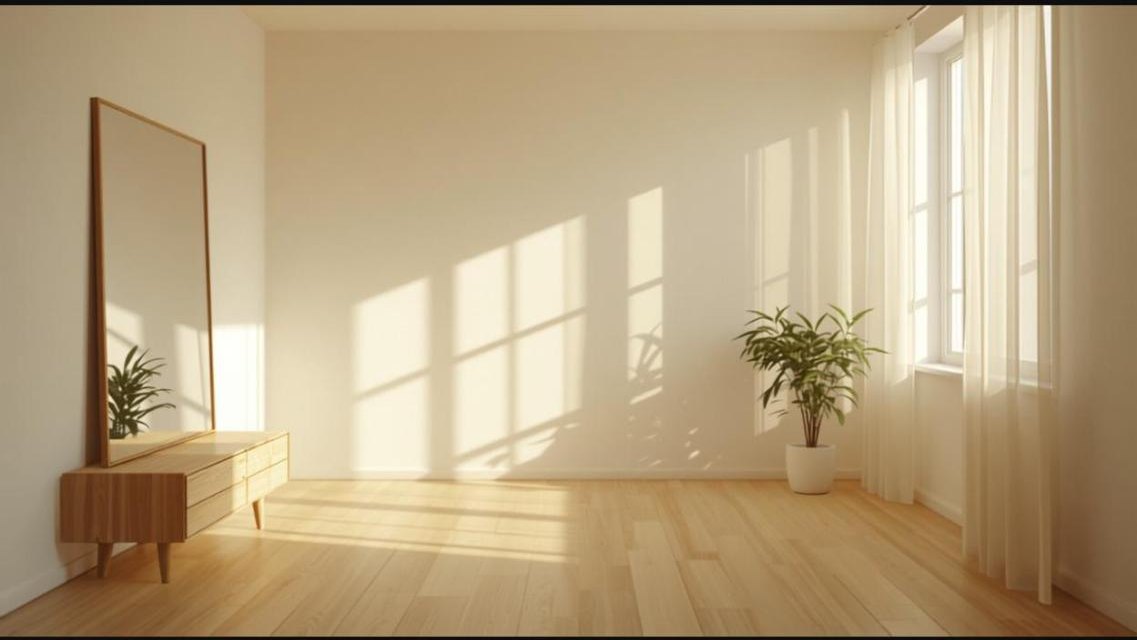
If you'd rather not touch the wall, a large leaning floor mirror is the easiest win here. You prop it and you're done. Running floor to ceiling, it pulls the eye upward so the ceiling feels higher, gives the deepest reflection of any single piece, and covers your full-length dressing mirror at the same time, so it earns its footprint twice.
One safety note worth taking seriously: strap the top to the wall. A tall mirror leaning on its own is a genuine hazard around kids and pets, and the strap hides behind the frame.
Shape and quality
Shape changes the feel more than you'd expect. Frameless reads as pure light and nearly disappears into the wall. An arched top adds a soft architectural moment and, like any tall shape, draws the eye up. A round mirror softens a boxy room and sits well over a console or sink. Whatever you pick, keep the frame thin, since a heavy ornate frame adds the visual weight you're trying to lose.
One thing worth spending on: the glass itself. Cheap mirrors can distort slightly or throw a faint green tint, which cheapens the whole effect on a piece this size. You don't need designer money, but read reviews for "wavy" or "warped" before you buy.
Common questions
Where should I hang a mirror to make a room look bigger?
Opposite a window if you can, so it catches daylight and bounces it back like a second window. If there's no wall directly opposite, hang it on a wall beside the window to grab the side light instead. On the end wall of a narrow room it adds depth; on a long wall it widens the space. Just make sure it reflects something worth seeing rather than a blank or cluttered wall.
What size mirror works best in a small room?
Aim for roughly two-thirds the width of the furniture below it, or a tall floor-length piece on a bare wall. One large mirror does far more than several small ones, both for the light it reflects and for the sense of scale that makes the wall feel like it has room to breathe.
Do leaning floor mirrors really work, or just look nice?
They genuinely work, and they need no drilling. The floor-to-ceiling height adds the deepest reflection you can get from one piece and lifts the ceiling, and it doubles as a full-length mirror. Lean it near a window for the light, and strap the top so it can't tip.
Our product picks
CIRCUMI Arched Wall Mirror (36"x48")
A tall arched shape draws the eye up and reflects a whole wall's worth of light. The go-to if you're buying one mirror to open up a small room.
Check price on Amazon →Antok 71" Arched Full-Length Leaning Mirror
Props against the wall for instant height and floor-to-ceiling depth, and covers your full-length-mirror needs too. Renter-friendly and easy to move. Strap the top for safety.
Check price on Amazon →Better Bevel 24" Frameless Round Mirror
A thin, frameless edge adds no visual weight, just light. Softens a boxy room and looks right over a console, an entry table, or a sink.
Check price on Amazon →Buy big, hang it toward the light, and point it at something worth doubling. That's the method. For the rest of the playbook, see our guide to making a small room look bigger.