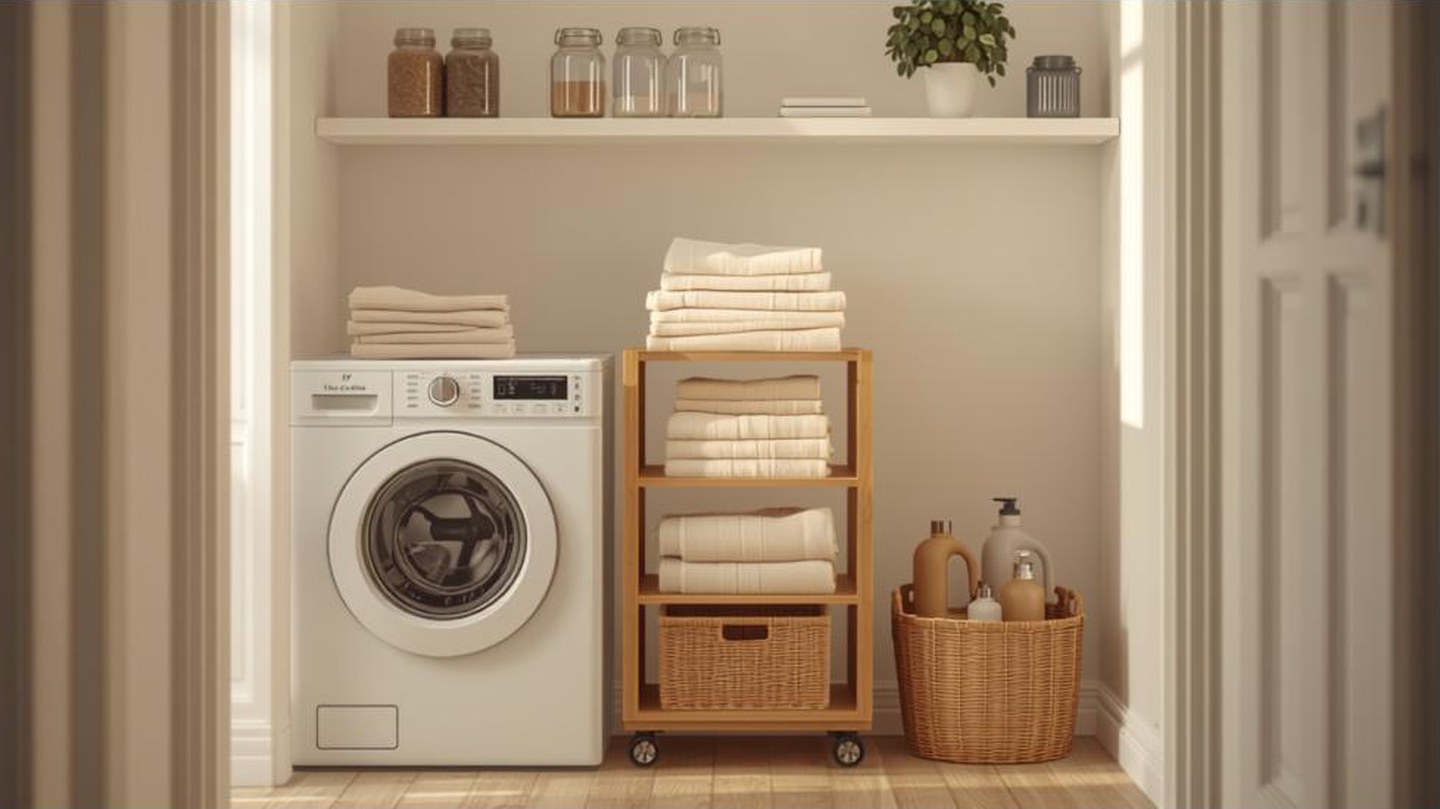
Laundry is the chore small apartments handle worst. No dedicated room, often no proper hamper, and the machines (if you have your own) crammed into a closet with dead space all around them: the result is a pile on a chair and detergent on the windowsill. Treat it like any other small-space storage problem: go vertical, use the gaps, pick pieces that roll or fold away. Here's the full setup, whether you have a stacked washer-dryer in a closet or you haul a basket to a shared machine down the hall.
The short version: work three zones. Contain the dirty clothes with a slim divided hamper, use the vertical space above and beside the machines with shelving and a tension rod, and claim the skinny gap next to the washer with a pull-out cart. Share a laundry room? Add a rolling cart or sturdy tote so everything moves in one trip. Start with the hamper; the pile on the chair is the whole problem.
Contain the dirty clothes
Everything starts with a real hamper, because the pile of clothes with nowhere to go is what makes laundry feel chaotic. The best small-space hampers are slim, tall, and divided, so you presort lights and darks as you go and wash day becomes grabbing a bag instead of sorting a heap. A collapsible one folds flat when empty; a rolling one or a lift-out bag saves your back on a full load. Tucked into a closet corner or the gap beside a dresser, it takes almost no floor and ends the chair-pile for good.
Go vertical above the machines
If the washer and dryer are yours, the most wasted space in the apartment is usually the air right above them. A freestanding over-the-machine shelving unit turns that dead zone into storage for detergent, baskets, and folded laundry, and an in-closet stacked setup gains the most from it. Add a tension rod alongside to hang shirts straight out of the dryer so they wrinkle less. Freestanding shelving needs no drilling, so it lifts out clean when you move. Measure your clearance first, since stacked machines and low closet shelves don't leave much headroom.
Claim the gap beside the washer
There's almost always a narrow gap, a few inches, between the washer and the wall or cabinet. It's the perfect home for a slim rolling cart: a pull-out tower that fills that skinny dead space with detergent, dryer sheets, and stain sprays, then rolls out when you need it and tucks back when you don't. It's the same trick as the slim cart beside a fridge, applied to the laundry corner. Measure the gap first, because these come in set widths and a too-wide one just won't fit.
If you use a shared or laundromat machine
No machines of your own changes the game: the goal becomes moving everything in one trip and storing it flat between wash days. A rolling cart or sturdy wheeled basket hauls a full load, detergent, and supplies down the hall or to the car in one go, and a backpack-style laundry bag frees your hands on stairs. Between washes, a collapsible hamper stores flat and a small caddy keeps detergent and your quarters or laundry card together, so nothing's missing when it's time to leave.
Corral the supplies
Detergent, softener, dryer sheets, stain sticks, and lint rollers sprawl fast. Keep them in a single caddy or bin so the whole kit moves as one and doesn't colonize a shelf or windowsill. If the machines are out in the open, decanting bulk detergent into a slimmer dispenser saves a little space and looks tidier. The goal: everything laundry-related lives in one grabbable spot, so wash day means picking up one caddy instead of gathering supplies from three corners of the apartment.
Common laundry storage mistakes
The traps here are mostly about measuring and moisture. Buying before you measure, then finding the over-washer unit won't clear a stacked dryer or the gap cart is an inch too wide. Storing anything damp in a closed cabinet, which is how a tucked-away laundry corner starts to smell musty; leave a door cracked and never shelve a damp towel. And buying a hamper too big to move, so a full load becomes a two-hands, two-trips job instead of one grab. Match every piece to the space and the trip, not just the storage it promises.
Common questions
Where can I dry clothes in a small apartment without a dryer?
Lean on vertical and foldaway gear: a wall-mounted drying rack that folds flat, a tension rod strung across an alcove or over the tub, or an accordion rack that opens over the machine and collapses after. Route the airflow so things actually dry, near a cracked window or a running fan, since a small closed room plus wet laundry is how you get that damp smell. A single foldable rack covers most loads and disappears against the wall when it's empty.
Can I put laundry storage in the bathroom instead?
Often the smartest move, since the bathroom is usually the closest thing to a utility space you've got. An over-the-toilet shelf or a slim cabinet holds detergent and folded towels, and the shower rod doubles for hang-drying. Just keep detergent and paper supplies off the floor and away from splashes, and account for the humidity: closed bins beat open baskets for anything you don't want going damp.
Our product picks
SOLEDI 3-Section Divided Laundry Hamper
Tall, narrow, and split for lights and darks so sorting happens as you go. Tucks into a closet corner or a gap, and it's the buy that ends the pile on the chair.
Check price on Amazon →U13 Over-the-Washer/Dryer Storage Shelves
Freestanding shelving that straddles or stands beside the machines, turning the wasted air above them into storage for detergent and baskets. No drilling for renters. Check your clearance before ordering.
Check price on Amazon →7.1" Slim Rolling Laundry Cart (4-Tier)
Rolls into the narrow gap beside the washer as a pull-out tower for detergent and supplies, then tucks away. Measure the gap first, since these come in set widths.
Check price on Amazon →Build around what you've got, give every part of the chore a designated home, and laundry stops being the thing you dread in a small apartment.